1. Product Characteristics of Ethyl Acetate
Ethyl acetate (C₄H₈O₂, CAS 141-78-6) is one of the simplest carboxylate esters, formed from ethanol and acetic acid . It is a colorless liquid with a characteristic sweet, fruity odor often associated with pear drops or nail polish remover .
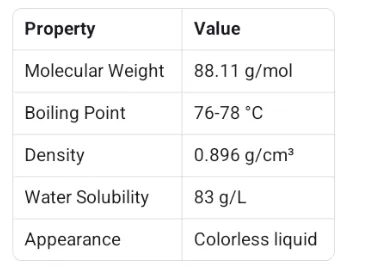
Key Physical Properties :
Safety Classification :
· Highly flammable liquid and vapor (H225)
· Causes serious eye irritation (H319)
· May cause drowsiness or dizziness (H336)
Ethyl acetate is valued for its low toxicity compared to alternative solvents, pleasant odor, excellent solvency power, and biodegradability, making it an environmentally favorable solvent option .
2. Production Processes of Ethyl Acetate
Ethyl acetate can be produced through several industrial routes, with Fischer esterification being the most dominant (approximately 85% of global production) .
2.1 Fischer Esterification (Dominant Route)
The classic acid-catalyzed esterification of ethanol and acetic acid remains the most widely used commercial process :
CH₃CH₂OH + CH₃COOH → CH₃COOCH₂CH₃ + H₂O
Process Features :
· Catalyst: Strong acids (historically sulfuric acid; increasingly solid acid resins or heteropoly acids)
· Conditions: 70–100 °C under reflux or in reactive distillation columns
· Yield: Overall yields >95% with recycling
· Advantages: Well-established technology, suitable for continuous operation, high conversion rates
Water is continuously removed during the reaction to shift the equilibrium toward ethyl acetate formation .
3. Applications of Ethyl Acetate
Ethyl acetate is one of the most widely used solvents in the chemical industry, with applications spanning multiple sectors.
3.1 Paints, Coatings, and Inks (Largest Segment)
Paints and coating formulations account for approximately 52.83% of global ethyl acetate consumption.
· Applications: Solvent for nitrocellulose lacquers, varnishes, automotive paints, architectural coatings, and industrial coatings
· Key Properties: Fast drying time, excellent solvency for resins, smooth finish
· Printing Inks: Essential for flexographic and rotogravure printing inks used in flexible packaging
3.2 Adhesives and Sealants
Second-largest application segment .
· Dissolves acrylics, vinyls, epoxies, and polyurethanes
· Quick drying time ideal for fast-setting applications
· Lower toxicity alternative to hazardous solvents
3.3 Pharmaceutical Industry
Accounts for approximately 28% of global consumption (2024), projected to reach 35% by 2032 .
· Extraction and Purification: Used for active pharmaceutical ingredients (APIs) and intermediates
· Drug Formulations: Safer alternative to more toxic solvents
· Biotechnology: Extraction solvent for natural products and fermentation-derived compounds
3.4 Food and Beverage Industry
Ethyl acetate holds GRAS (Generally Recognized As Safe) status and is approved for food processing applications .
· Decaffeination: Primary solvent for decaffeinating coffee and tea
· Flavoring Agent: Natural flavor enhancer in ice creams, cakes, candies, and confectionery
· Extraction Solvent: Used in natural flavor extraction processes
3.5 Other Applications
· Cosmetics and Personal Care: Used in nail polish removers, perfumes, and fragrances
· Laboratory Solvent: Common solvent for column chromatography and thin-layer chromatography
· Industrial Cleaning: Effective solvent for degreasing and cleaning applications
4. Market Analysis and Development Prospects
4.1 Market Size and Growth
The global ethyl acetate market is experiencing robust growth, though estimates vary across sources:
Source | 2024/2025 Market Size | 2032/2034 Forecast CAGR |
Fortune Business Insights | USD 5.00 billion (2025) | USD 9.50 billion (2034) 7.3% |
24ChemicalResearch | USD 4.35 billion (2024) | USD 7.12 billion (2032) 6.1% |
Market Research.com | 4.53 MMT volume (2024) | 6.45 MMT volume (2034) 3.6% |
4.2 Regional Analysis
Asia Pacific dominates the market:
· Accounts for approximately 47.7–82% of global market share
· China is the largest producer and consumer (60% of global capacity)
· India emerging as major producer leveraging bio-ethanol supply
· Driven by automotive industry growth, construction activities, and packaging sector expansion
North America:
· U.S. market projected to reach USD 0.9 billion by 2026
· Growth driven by automotive applications
· Natural gas-based acetic acid and corn-based ethanol provide cost advantages
Europe:
· Strong demand from pharmaceuticals, food & beverage, and cosmetics industries
· Strict environmental regulations favor low-toxicity solvents
· Germany, France, and UK are major contributors
4.3 Key Market Drivers
1)Expanding Pharmaceutical Applications
· Drug development pipelines expanding globally
· Ethyl acetate demand in pharmaceuticals increased 18% since 2021
2) Growing Packaging Industry
· E-commerce and retail growth driving flexible packaging demand
· Ethyl acetate is a key component in food packaging adhesives
3) Rising Construction Activities
· Particularly in China and India
· Ethyl acetate consumption in adhesives, coatings, and sealants directly correlated
4)Food Industry Growth
· Global decaffeinated coffee market expected to grow at 6.5% CAGR
· Increasing demand for processed food containing artificial flavors in developing countries
5)Sustainable Production Trends
· Bio-based ethyl acetate production capacity increased 22% in 2024
· Growing consumer preference for green solvents
5. Summary
Ethyl acetate is a versatile, low-toxicity solvent with applications spanning paints & coatings, pharmaceuticals, food processing, adhesives, and emerging electronics sectors. The market is projected to grow at a CAGR of 6–7% through 2034, driven by expanding end-use industries in Asia Pacific and the shift toward sustainable, bio-based production methods .
While traditional Fischer esterification remains the dominant production route (85% of global capacity), the industry is increasingly adopting ethanol-based single-feed processes and fermentation technologies to improve sustainability and reduce fossil fuel dependence. Asia Pacific, particularly China and India, will continue to lead both production and consumption, supported by strong construction, automotive, and packaging sector growth .
Key Success Factors for the Future:
· Investment in bio-based production capacity
· Development of energy-efficient purification technologies (e.g., dividing-wall columns)
· Expansion in high-purity grades for electronics applications
· Circular economy initiatives for solvent recovery